Perfluorooctanoic Acid: Our Past Decisions, Today’s Concerns, and Tomorrow’s Choices
A Chemical Shaped by Industry History
Perfluorooctanoic acid, often shortened as PFOA, tells a story that stretches back to the 1940s. Industry pioneers didn’t foresee the environmental impact at a time when convenience and durability in consumer goods took priority. PFOA became a backbone for making products water-resistant and grease-proof. The non-stick coatings on pans, the waterproof jackets, weather-resistant packaging — each owes something to the chemistry behind PFOA and its cousins in the per- and polyfluoroalkyl substances (PFAS) family. Looking at that history, it’s impossible to separate the technological optimism of earlier decades from the side-effects we face now.
What Is This Stuff, Really?
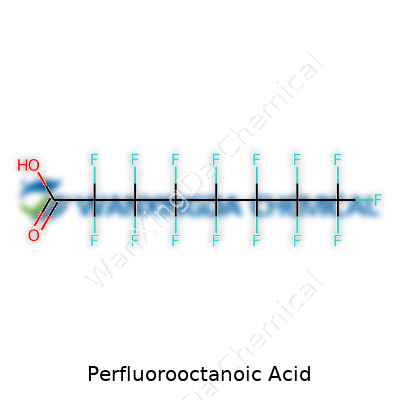
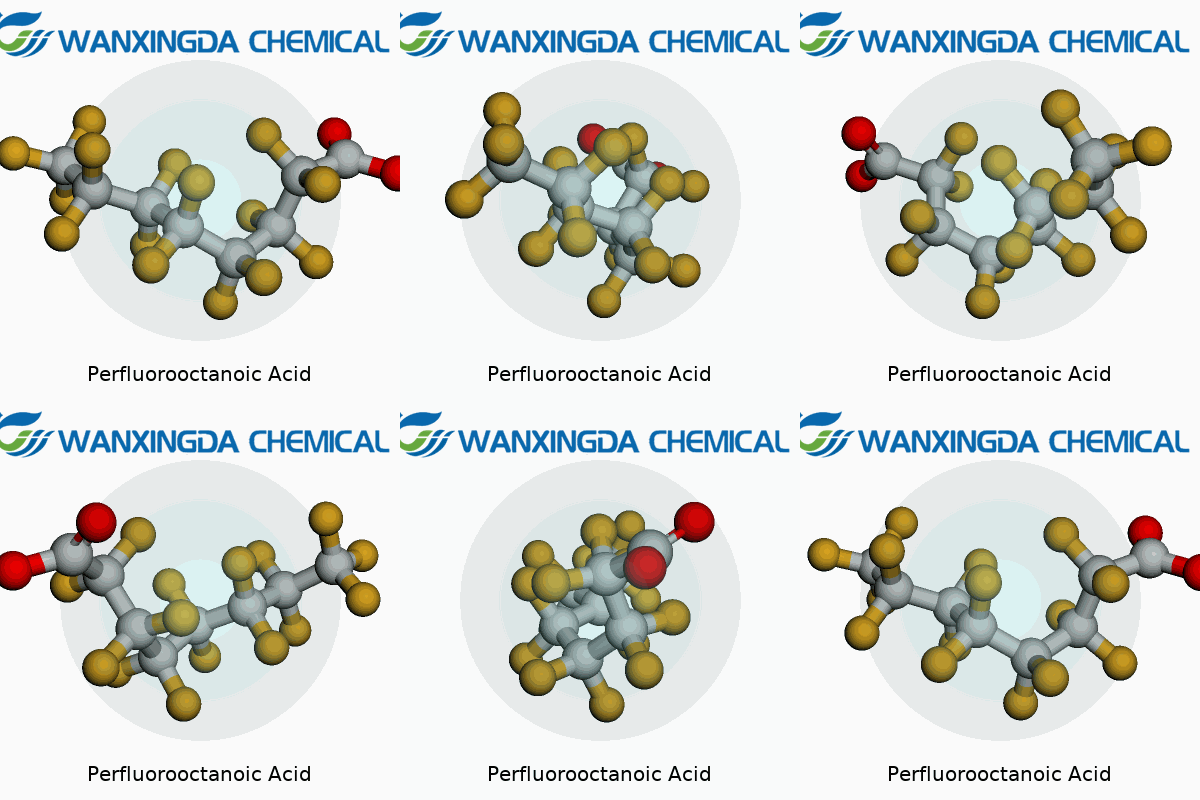
PFOA doesn’t act like normal chemicals. Its unique carbon-fluorine bonds bring stubborn resistance to heat, acids, and bases. This explains why it became so attractive in manufacturing, lending toughness to Teflon and stain-repellent textiles. In pure form, it appears as a white powder or waxy solid, with a molecular weight and melting point that allow easy handling for industrial processes. Its structure — an eight-carbon chain fully wrapped in fluorine atoms, with a carboxylic acid group — seems simple but hides a double edge: powerful performance, and the stubborn persistence that now raises alarm.
Behind the Label: Not Just a Chemical Name
This substance shows up under multiple guises. Chemists know it as C8, pentadecafluorooctanoic acid, or perfluorocaprylic acid. Each name marks a spot in science history, tucked into scientific journals and regulatory lists. Whether sold in bulk drums for industrial production or popping up as a trace contaminant, PFOA’s aliases mark its spread across supply chains. Buying or working with these chemicals means watching for these names across documents. Wherever these words appear, questions about safety, disposal, and environmental impact follow close behind.
How Industry Put PFOA to Use
Companies saw PFOA as a sort of workhorse. Its ability to repel water and oil led to countless uses: coatings for non-stick cookware, water-repellent shoes, stain-resistant carpets, and greaseproof food wrappers. It also served as a processing aid in fluoropolymer manufacture. Each use seemed like a simple technological advance. Over decades, its footprint grew so wide that trace amounts started showing up in the environment, in human blood samples, and even in remote wildlife. Many households unknowingly became PFOA’s final destination, even though only a small number of factories actually handled the concentrated stuff.
Watching Out for Hazards and Handling Standards
Taking a casual approach to PFOA brings risks. The chemical resists breakdown, making it tough to dispose of safely. Workers who handled it decades back, often lacked strong protections. Nowadays, factory standards demand gloves, respiratory protection, and closed systems to prevent leaks. Federal agencies and environmental watchdogs keep tightening the exposure limits, prompted by research into health dangers. There’s no easy way to reverse the spread, but simple steps like using alternatives and demanding transparency on chemical use make a difference. Facility audits, wastewater controls, and routine blood tests for exposed workers now stand behind every kilo produced or used.
Digging Into the Core Chemistry
Making PFOA takes a specialized approach. The old electrochemical fluorination methods use electricity and a cocktail of poisonous gases to swap hydrogen for fluorine along the carbon chain. Another approach, telomerization, can also create chemicals with similar backbone structures, setting the stage for further tweaks by chemists. Once in hand, PFOA doesn’t react easily in the environment — that is both its value to industry and the root of the persistent pollution we see today. Scientists have tinkered with its structure for decades, creating shorter or longer chains, making tweaks to try to reduce toxicity or improve performance. Despite these tweaks, no method has managed to solve the persistence problem entirely.
Science Digs Deeper: Toxicity and Health Impacts
PFOA’s effects don’t stay locked away in labs. Water supplies near manufacturing sites show rising levels, while studies recognize higher blood concentrations in people who live nearby. Health researchers connect long-term exposure with cholesterol changes, immune problems, some forms of kidney and testicular cancer, and possible effects on fetal development. It doesn’t break down in the human body, so every exposure stacks up through the years. Large-scale studies in exposed communities, like those near Parkersburg, West Virginia, helped make the health risks impossible to ignore. Cities and states have started pushing for limits in drinking water — a clear sign that science and policy are racing to keep up with past mistakes.
PFOA’s Legacy in Research and Industry
Modern laboratories spend time and money developing safer alternatives, while also mapping out routes to destroy or capture the PFOA that’s already leaked into groundwater. Treatment plants try advanced filtration, such as activated carbon or high-pressure membranes, but removing years of contamination costs time, money, and relentless monitoring. Some companies opt for shorter-chain PFAS, but new studies suggest these don’t really solve the pollution puzzle. Ongoing research focuses on developing molecules that offer performance without long-term risks. Chemists and environmental scientists often work hand-in-hand, pressured by growing public awareness and tighter regulations.
Looking Toward Solutions
The road ahead calls for strong action — both by industry and government. Implementing strict limits, enforcing cleanup at contaminated sites, and phasing out persistent chemicals all demand stamina. Companies need to embrace alternatives that have been tested not just for immediate utility, but for long-term health and ecological impacts. Individuals can pressure their leaders, ask questions about product ingredients, and support organizations working on chemical safety. Watching regulators in the US and Europe struggle with how to draw the line shows how tricky these decisions can be. New methods like nonfluorinated coatings or scaling up destruction technologies, like supercritical water oxidation, provide hope that smart investments now can keep another PFOA-like problem from hitting in the future.
The Importance of Learning from Experience
Peeling back the layers of the PFOA story, I see echoes of broader patterns in the chemical industry. The chemical offered unique benefits and years of commercial success, but cutting corners on testing and underestimating environmental costs built up problems that are still with us years later. Whether working in a research lab or buying consumer products, we all have some part to play. Speaking up, supporting unbiased research, and holding both regulators and manufacturers accountable matter just as much as finding new technological fixes. The challenge with PFOA isn’t just technical — it’s about making sure long-term safety, transparency, and precaution guide future choices, instead of short-term gains. That lesson matters as the search for better and safer alternatives continues.
Understanding PFOA in Daily Life
Most people have heard of nonstick pans, maybe even own a few. Perfluorooctanoic acid, or PFOA, played a big part in making those surfaces as slippery as they are. DuPont and 3M started using PFOA decades ago to produce Teflon coatings and similar products. It’s not just frying pans—PFOA shows up in water-repellent fabrics, stain-resistant carpets, fast food wrappers, and even firefighting foam.
Some might think a chemical used in so many household staples couldn’t be all that risky. The problem is no one invited PFOA into the bloodstreams of the majority of Americans, yet testing consistently reveals traces there. This stuff doesn’t break down easily, either. Researchers call PFOA a “forever chemical”—once it turns up somewhere, it sticks around for a really long time.
The Cost of Convenience
Growing up, the appeal of water-resistant jackets or oven-cleaning sprays never raised suspicion. It was just modern living. After digging into studies on PFOA, things look different. Scientists have linked long-term exposure to increased risk of certain cancers, thyroid disorders, and lower birth weights. Agencies including the EPA and CDC back up those claims with evidence from cohort studies tracking both workers who handled the chemical and regular people just living their lives nearby.
The slow realization of health risks caught manufacturers off guard back in the early 2000s. By 2015, big chemical companies started phasing out PFOA under mounting regulatory and public pressure. Even so, older products remain in homes, and contaminated water supplies stick around for decades. Places like Parkersburg, West Virginia, saw high-profile lawsuits because groundwater near factories tested positive for PFOA.
Taking Steps Toward Safer Living
The good news: innovation can work in our favor. Some companies started rolling out alternative chemicals with shorter lifespans in the environment. While those new options need careful scrutiny, progress can’t start until we face what’s already in circulation.
On an individual level, knowledge leads to better habits. Swapping old nonstick pans for stainless steel or cast iron is a simple move. Checking labels on stain-resistant upholstery offers a chance to opt out of unnecessary chemical exposure. Community action, like advocating for better cleanup of contaminated water supplies, matters just as much as choices at home.
Scientists keep pushing for more transparent testing, clearer labeling, and stricter regulation of new chemicals before they hit store shelves. Trust doesn’t happen overnight; it builds through honest reporting and strong oversight. Across the kitchen cupboard, the living room floor, and even the neighborhood water supply, the legacy of PFOA reminds us that living conveniently sometimes comes with costs. The responsibility now sits not just with companies, but with anyone who cares about the future of public health.
The Real Side of Chemical Exposure
I remember the first time I read about perfluorooctanoic acid—PFOA—in a story about nonstick pans. The idea of invisible chemicals sneaking into daily life stuck with me. PFOA isn’t rare. Until recently, factories poured it into rivers and smokestacks. It’s turned up in food packaging, stain-resistant furniture, and even the tap water in some neighborhoods.
The big question is whether PFOA causes harm. Research points to a difficult truth. Decades-old studies found people living near chemical plants with PFOA in their water faced higher odds of kidney and testicular cancer. Health agencies like the U.S. Environmental Protection Agency say there’s “suggestive evidence” linking PFOA with several types of serious illness, including high cholesterol, thyroid problems, and immune system effects. Exposure during pregnancy might affect a developing baby’s weight or health.
Why It Sticks Around—And Why That’s a Problem
PFOA doesn’t break down over time. That’s part of the problem. It piles up in water, soil, fish, and, ultimately, people. Experts call it a “forever chemical.” Blood tests show nearly everyone in the United States has at least some PFOA in their body, even folks living far from big factories. That’s a big reason public health researchers and communities are so worried.
Folks can’t see, smell, or taste PFOA in water or the food supply. Unless officials test for it, regular people have no way to know if their community faces a risk. Parents can’t tell if kids get exposed just by drinking a glass of water or eating food from certain packages.
How Bad Is It—And Who Pays the Price?
Some communities, especially those close to manufacturing plants, learned about PFOA the hard way. High-profile lawsuits forced companies to pay out hundreds of millions to people dealing with pollution in their drinking water. In those places, locals saw rates of certain cancers ticking up. Kids’ health seemed harder to protect. The frustration ran deep—especially for folks who didn’t get a say in the chemicals poured into their backyards.
Getting rid of PFOA once it’s in the water takes expensive filtration. Not every town or small rural system can afford the right fixes. Public water systems in several states now keep a closer eye on PFOA levels, and some set tough limits—sometimes lower than what the federal government recommends.
What Can Be Done?
The conversation about PFOA shifted as more studies rolled out. These days, many companies stopped using it in new products in the United States and Europe. Some countries banned PFOA completely. Filters using activated carbon or reverse osmosis can cut the risk at home—but they come with a price tag. Access depends on where you live and what you can pay.
Communities facing contamination need support—often in the form of stronger regulation and more money for cleanup. Preventing new pollution stands out as the best fix. Instead of waiting for health problems to show up, regulators and companies can keep risky chemicals out of the water and food supply in the first place.
Understanding chemical exposures like PFOA matters. The history of PFOA shows why science, public health, and clean water all count as basic rights—not just for families living near factories, but for everyone.
A Closer Look at PFOA’s Everyday Trail
Perfluorooctanoic acid—PFOA, as most folks know it—tends to show up in places that touch a lot of daily life, whether people realize it or not. It has been a quiet workhorse for years. Growing up near an industrial town, I always wondered why so many workers talked about “nonstick” stuff and complicated chemical names. Get to know this acid a little, and it becomes clear how much of modern convenience has leaned on it.
PFOA and the Nonstick Wave
Kitchens changed when nonstick cookware rolled out across America. Most Teflon pans, at least for decades, counted on PFOA somewhere in their process. That shiny fry pan that let scrambled eggs slide off without a fight? There’s a fair chance PFOA played a role in making that possible. Turns out, molecules with slippery features also keep food and sticky residues from welding to metal.
From Raincoats to Carpets—Resisting Water and Stains
Anybody who has dragged mud inside or spilled a drink knows the value of a carpet that shrugs off stains. Textile mills have used PFOA to help rugs and upholstery keep their color and resist water. Even outdoor gear like rain jackets and hiking boots have drawn from similar chemistry, boosting their ability to repel both water and muck. These treatments made life a whole lot easier for families, but the price for that convenience only came into focus much later.
PFOA in Packaging and Industrial Spaces
Walk down a grocery aisle. Boxes of microwave popcorn, fast food wrappers, and pizza boxes all need to handle grease. For many years, PFOA-based coatings did the job, keeping oils from soaking right through and turning a lunch into a mess. Beyond the store, factories have tapped PFOA for all sorts of things—from making wire coatings that insulate electronics, to giving industrial gaskets their grip against aggressive chemicals.
Health and Environment: Time for a Change
Learning about PFOA’s spread leads to bigger questions. Water supplies in some towns have tested positive for these “forever chemicals” because of run-off or industrial waste. The Centers for Disease Control and other health agencies keep tracking links between these chemicals and health problems, including thyroid disorders, certain cancers, and immune changes. Growing evidence pushed manufacturers and regulators to seek alternatives and stricter controls. The EPA has started to phase out PFOA use, leading the charge for safer substitutes.
Looking for Safer Solutions
Change doesn’t happen overnight in big industries. Some cookware brands have dropped PFOA, switching to different formulas. Clothing makers offer water-resistant coatings that skip these chemicals. Paper companies and packaging engineers are hunting for safer grease barriers that break down easily and don’t stick around long after they’ve served their purpose. Shoppers can play a part by asking questions and choosing products labeled as PFOA-free. As more people learn about these choices, the demand for cleaner chemistry grows stronger.
I’ve seen that real progress usually comes from a mix of science, pressure from people who care, and companies willing to experiment. PFOA’s story in industry isn’t quite finished, but it’s clear that future generations deserve a world with fewer invisible risks clinging to the things we use every day.
Walk into any chemical storeroom, and it’s easy to get caught up in the numbers and paperwork. But Perfluorooctanoic Acid, better known as PFOA, pulls together decades of industrial convenience and health concerns. Most folks in the field remember stories about “forever chemicals” and drinking water warnings. The science backs up those worries: PFOA doesn’t break down easily. Once it gets into the ground or water, it likes to stay put, slowly moving through the environment, sometimes showing up in blood samples years later.
PFOA Isn’t Just Another Bottle on a Shelf
The persistent reputation PFOA has earned comes with responsibility. This isn’t a barrel you stash where it fits or move without a plan. Personal experience tells me that even a splash can stick around long after the floors have been wiped clean. This stuff finds the smallest cracks and holds on, resisting most regular cleanups.
PFOA usually gets handled in research labs, manufacturing, or waste facilities. These sites bear a duty to keep gear in good shape. Chemical-resistant gloves, splash goggles, and fits-sealed lab coats aren’t optional; they’re the first line of defense. More than once, workers found out late that standard nitrile gloves couldn’t quite keep PFOA away from their skin. It takes the right materials, checked often, before anyone grabs a container or shovel.
Storing PFOA Safely Means Respecting Its Longevity
Tucking a drum of PFOA in an office supply closet doesn’t cut it. Secure, well-marked chemical cabinets keep this acid away from sunlight, humidity, and foot traffic. Metal shelves with spill pans catch trouble before it spreads. Good ventilation slows down the build-up of airborne traces, protecting anyone nearby. No one wants to explain an unexpected spill or leak that led to a day-long evacuation or, worse, a costly cleanup that sticks around for years on the public record.
Common sense says don’t cut corners. Proper signage with hazard warnings lets even the night shift know what’s in the cabinet. A busy workplace needs clear rules about who has the key or code for that storage area. Especially in places where turnover is high, experienced hands can train new hires, passing down stories and caution. Regulators don’t look kindly on careless storage, and fines can devastate smaller outfits.
Dealing With Spills and Secrets
There are times when mistakes happen. Immediate action and upfront honesty work better than quiet coverups, something I’ve seen firsthand. Emergency kits with absorbent pads, neutralizing solutions, and chemical waste drums save time. People closest to the scene know who to call and which doors to shut off. Regular drills with clear instructions keep teams sharp, not scared.
Health authorities like the EPA and OSHA post frequent updates about PFOA. Their rules reflect real cases—years of lawsuits, persistent contamination, and even community relocations underline the need to tighten up old storage habits. Fewer new cases show up in places that plan regular inspections, keep gear available near storerooms, and set up disposal contracts with certified waste handlers.
Toward Smarter Handling in the Long Run
PFOA isn’t going away soon. As the world pulls back from using it, leftover stockpiles need the same care as new shipments. Sharing facts across companies and industries protects both human health and reputations. Proper storage and handling become a daily habit, not just a regulation to check off. The best workplaces think before unlocking a cabinet, not after a news headline reminds them of what’s at stake.
Trust and Health Take Center Stage
Perfluorooctanoic Acid, or PFOA, landed in the conversation years ago for one main reason: its impact doesn’t just vanish after use. It has a knack for showing up in blood samples, rainwater, and even wildlife. Once a key player in nonstick cookware, waterproof fabrics, and food packaging, it raised serious questions as scientists connected it to health issues like thyroid disruption and some cancers. Learning about this made me reevaluate the pan I grabbed for eggs each morning.
Past Lessons About Persistent Chemicals
The story isn’t new. Many of us remember watching stories unfold about asbestos and leaded gasoline. Society often takes too long to step away from chemicals once branded as essential, even once the risks show up in plain sight. If there’s a lesson, it’s this: moving away from hazardous materials lags far behind our discovery of their harm. Many manufacturers cut PFOA out after global pressure mounted, but safer replacements have moved in at a crawl.
Alternatives in Action
One major alternative, GenX, entered the scene with promises to be less toxic and less persistent than PFOA. Reality hit differently. Recent studies detected GenX chemicals in local rivers and even in some tap water, showing the substitute can build up just like PFOA. Some folks argue that the fix feels like a side-step, not a step forward.
Silicone coatings gained traction as well. They offer slick surfaces and good temperature resistance. I’ve used silicone bakeware at home, appreciating its flexibility and safety claims. It doesn’t last as long in harsh industrial settings and often costs more, but many people appreciate the peace of mind with less chemical baggage.
Plant-based coatings, such as carnauba wax, pop up on food packaging and wrappers. They don’t last like PFOA–coated materials, but they break down after disposal. This shift aligns better with efforts to cut waste and reduce chemical footprints. Sometimes I see these wax-coated wraps at my local market, and I think about how change starts with small swaps, even if the convenience factor falters at first.
Barriers on the Journey
Higher costs, uncertain performance in tough manufacturing environments, and unfamiliarity get in the way of wider adoption. Manufacturers want solutions that support profit and production, but pressure builds from both customers and regulators. Bans and restrictions have a way of forcing progress, as blunt as they may feel when jobs and business stability are at risk.
The Path Forward
Regular people have a part to play. Anytime consumers ask about what’s in their clothing or cookware, it sends a signal. Lawmakers pick up on these signals. Businesses succeed when they can brag about low-toxicity practices, so another avenue involves support for companies looking past short-term savings.
Research matters most. Government funding, innovation contests, and risk-sharing among corporations get safe alternatives on shelves faster. Universities and labs need support to test coatings made from minerals or plants, figuring out if these options can stand up for everyday life. Openness about what works—and what doesn’t—matters for trust.
PFOA shaped an era in manufacturing that saw customer trust pay the price. Alternatives might not tick every box from the start, but moving toward safer chemicals always beats going backward. Each time someone demands more transparency or seeks out safer products, the manufacturing industry picks up that challenge.