Potassium Allyltrifluoroborate: A Closer Look at Its Journey and Role in Modern Chemistry
The Story Behind Potassium Allyltrifluoroborate
Potassium allyltrifluoroborate never appeared overnight in synthetic chemistry labs. The growth of organoboron chemistry traces back to Herbert C. Brown and his Nobel-winning work on hydroboration, which unlocked a treasure chest of boron-based reagents. These discoveries gave chemists new, more precise ways to build carbon frameworks. Potassium allyltrifluoroborate is a direct offshoot of this lineage. As cross-coupling chemistry flourished, especially after the 1970s, researchers kept searching for boron reagents that would bring both ease of handling and broader applicability. Many early boron compounds either decomposed too fast or challenged chemists with tricky purification. Solid, bench-stable, water-tolerant reagents like potassium allyltrifluoroborate began making waves, showing up consistently in academic papers from the late 1990s onward. The material opened doors that pinacol boronate esters or boronic acids sometimes kept closed. After using boron reagents for Suzuki couplings in the lab, the hassle of purification and sensitivity of some options made these new, more robust reagents a welcome change.
Understanding the Compound: Physical and Chemical Personality
Potassium allyltrifluoroborate doesn’t look like anything fancy: typically its powder is white or off-white, with little odor, a low profile in a bottle. Drop it in a drawer and it’ll stay stable, thanks to its ionic nature and crystalline structure. Unlike boronic acids, it resists the air and moisture with an almost stubborn indifference. Solubility gives it some quirks—potassium ions don’t play well with nonpolar solvents, but most organic chemists working with water or mixed aqueous-organic systems find it reliable. In chemical behavior, the trifluoroborate component excels at holding its boron atom tight, so the molecule keeps its shape until prompted during Suzuki-type couplings or other cross-coupling reactions. These are the workhorses that build carbon-carbon bonds, something modern material and pharmaceutical chemistry cannot ignore.
Preparation, Reactions, and the Value of Reliability
Synthesizing potassium allyltrifluoroborate calls for care but doesn’t require an industrial setup. Labs commonly start from allylboronic acid pinacol ester or a boronic acid and react with potassium hydrogen fluoride or other fluoride sources. Trifluoroborate salts come out the other side, often pure enough with basic recrystallization. What stands out to me—having run variations of these reactions—is the sense of security these stable salts give compared to finicky boronic acid intermediates that sometimes decompose just when you need them stable. In Suzuki-Miyaura reactions, these salts trade reactivity for shelf-life, which for practical chemists often means fewer ruined experiments and lower costs over time. Modifications happen via functional group interchanges on the allyl fragment or downstream cross-coupling. Chemists have drawn up a decent playbook for translating an allyltrifluoroborate into alcohols, amines, or more elaborate carbon chains, which makes this reagent a bit of a Swiss army knife.
Labeling, Transparency, and Standards on the Market
On the shelf, potassium allyltrifluoroborate goes by a few names. Sometimes it turns up as “allyltrifluoroborate potassium salt” or “potassium (prop-2-en-1-yl)trifluoroborate” on labels. I have seen suppliers shift between these descriptions, which can trip up searches by new students but never changes the compound in the jar. Chemical labels focus on handling, hazard statements, and quality checks, often with batch purity above 95 percent. Labs take care with calibration—potassium allergy for the rare few, some mild irritant handling guidance, little else. It’s not a compound that brings drama to the inventory, and you don’t hear tales of mysterious explosions or ghost injuries like with some reagents. That being said, the industry takes the low-hazard profile seriously, following broad chemical hygiene standards even for materials with a quiet reputation.
Applications Reaching into Industry and Academia
As a workhorse reagent, potassium allyltrifluoroborate fits into organic synthesis, pharmaceutical research, and even material science. Medicinal chemists often choose it for building blocks that will eventually become complex molecules—cancer drugs, antivirals, agrochemicals. Suzuki couplings demand reliability, especially in late-stage modification or scale-up. Material scientists also noticed its stability, using it to stitch together polymers or surface coatings. In my time in research labs, parallel experiments with trifluoroborate salts cut down on repetition and waste because the reagents could wait out a weekend or travel between collaborators without degrading. The predictable reactivity profile made these reagents favorites for both teaching and high-throughput screening.
Safety, Toxicity, and How Chemists Navigate Risks
Potassium allyltrifluoroborate holds a reputation for mildness, but no lab gets careless around chemicals. Acute toxicity studies point to low oral and dermal toxicity; even so, the compound still meets the fate of all synthetic intermediates: gloves, goggles, and decent ventilation. Environmental fate also gets scrutiny—it resists breakdown compared to some organoboron compounds, yet fluorinated intermediates can raise eyebrows about long-term persistence. Waste protocols adapt to evolving standards, never assuming yesterday’s low-risk status will stick forever. There’s regular review, as the spread of trifluoroborate popularity brings more waste streams and environmental touchpoints. Most labs, in my experience, treat it better safe than sorry, with dedicated boron waste containers even when few regulations demand it outright.
Research and the Road Ahead
Chemists continue to probe what potassium allyltrifluoroborate can do, and the compound rarely has a quiet moment in the literature. Teams chase new catalysts, trying to open up coupling to new partners or lower the reaction temperature. Researchers tinker with ways to make boron reagents more selective, less expensive, and easier to recycle. The drive for greener chemistry pressures the entire field, and organoboron reagents hold promise—no heavy metals, often less waste, better atom economy—if the details can be sharpened. As bioconjugation, small-molecule drug development, and functionalized polymers all explode in complexity, stable and tunable boron reagents secure more fans. There’s also a move toward automation—robots in chemistry labs thrive when reagents don’t spoil in hours—and potassium allyltrifluoroborate scores high marks.
Looking Forward: Real-World Impact
The world has no shortage of synthetic challenges, from next-generation drugs to advanced battery materials. Reagents like potassium allyltrifluoroborate don’t make headlines, but they underpin progress through stability, predictability, and open-ended potential. Seeing these compounds move from lab curiosities to must-have staples showed me how incremental innovations—tweaking a leaving group, improving a salt—reshape what's possible. The chemistry community should keep asking how to recycle, improve, or reimagine these reagents for a world that expects both powerful science and real environmental accountability. Potassium allyltrifluoroborate stands ready for the challenge, with plenty left to prove in the years to come.
A Little-Known Reagent Makes a Big Impact
Ask any experienced synthetic chemist about potassium allyltrifluoroborate, and you’re likely to get a nod and a knowing smile. This is not some household chemical that has found its way into cleaning sprays or food additives. Its value lives in research labs and reaction flasks, where creative science shapes new pharmaceuticals, materials, and tools that touch our lives downstream. Having spent time among the glassware, I’ve seen firsthand how this modest white solid allows tough chemical transformations to happen with far less fuss.
Opening New Doors for Synthesis
Synthetic organic chemistry runs on the ability to build complex molecules in a reliable way. Potassium allyltrifluoroborate makes this job a bit easier. It acts as a stable building block for adding a three-carbon chain—the “allyl group”—into all sorts of molecules, including those at the core of medicines, fragrances, and advanced polymers. The real magic comes from the trifluoroborate part, which gives the compound rare stability and makes it easy to handle in air and water. That single property changes everything. Suddenly, reactions that once demanded airtight flasks, dry solvents, and specialized gear become possible with much less caution. People in the lab appreciate anything that keeps procedures simple and results clean.
Helping Drug Discovery and Beyond
Adding an allyl group to a molecule changes its properties dramatically. Sometimes it nudges a potential drug just enough to make it active in the body or helps it avoid being broken down by the liver too quickly. Researchers value potassium allyltrifluoroborate for its reliability—it attaches these groups with precision, so chemists spend less time troubleshooting finicky reactions and more time moving projects along. More productive chemistry labs mean faster progress in finding and producing new medicines.
A Greener Choice for Modern Chemistry
Older methods for these types of chemical reactions used reagents that can ignite or react dangerously in the air. Potassium allyltrifluoroborate doesn’t share those problems. It’s stable enough that you don’t have to treat it like a ticking time bomb, which reduces spills and exposure to hazardous fumes. This matters to me personally—seeing fewer close calls in the lab makes it a better place for everyone. On a bigger scale, safer chemicals lead to less environmental risk and lower waste, aligning with the push toward more sustainable research and manufacturing.
Opportunities and Everyday Challenges
Of course, the journey from reagent jar to lifesaving drug isn’t straightforward. Each chemical building block needs fine-tuning to fit into the specific puzzle a chemist faces. Sometimes potassium allyltrifluoroborate falls short for certain types of molecules or reaction conditions, so it’s not a universal fix. Even so, its reliability has helped researchers solve tough problems. Keeping up with new research and improvements will continue to reveal creative ways to use this compound more broadly.
Keeping Science Moving
A small, specialized molecule like potassium allyltrifluoroborate rarely gets much attention outside chemistry circles, but its advantages ripple far. It makes modern synthetic chemistry less hazardous, more predictable, and faster. From that perspective, it’s no surprise that so many chemists keep a supply close at hand, ready for the next big discovery that starts at the molecular level.
The Structure at the Core
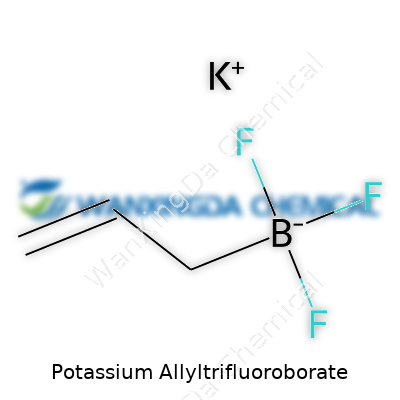
Potassium allyltrifluoroborate stands out for a simple formula: C3H5BF3K. This single line packs a lot into a small space—an allyl group, a cluster of fluorine atoms, boron, and potassium all gathered in one place. No one gets into organic chemistry purely for the thrill of memorizing formulas. The stories these compounds tell matter more. Potassium allyltrifluoroborate’s makeup isn’t just trivia—it speaks to years of work in labs all over the world, where people wrestle with tricky molecules because better chemistry powers everything from medicine to new electronics.
Why Care About the Formula?
Every element in this formula does some heavy lifting. The trifluoroborate group gets plenty of attention for its stability. Three fluorine atoms create a strong protective shell around boron. This makes the molecule more patient when sitting around in bottles or waiting for a chance to join a reaction. Potassium’s role as a counterion looks simple but shaping reactivity matters. Looking back at my years in an academic lab, I always preferred working with compounds that didn’t decompose overnight or turn into a sticky mess in the fridge. Potassium allyltrifluoroborate keeps its cool. That gives researchers more confidence setting up complex reactions, like Suzuki-Miyaura couplings, where a stable allyl source pays off.
Real-World Impact: More Than Just Numbers
Some might glance over another chemical name, but inside the formula is a signal to innovation. In drug development, the drive to swap out functional groups safely means plenty of eyes turn to new organoboron compounds. Traditional routes called for chemicals that felt precarious—a whiff of air or splash of water could spoil days of work. The trifluoroborate’s ruggedness cuts down on this waste. This shift supports greener chemistry in the lab and industry, trimming unnecessary byproducts and hazardous waste.
Think about where this fits in the bigger picture. My experience working alongside environmental chemists taught me the value of choosing building blocks that both perform well and reduce risk. Companies seek protocols offering both safety and speed, especially as regulations tighten worldwide and teams aim to reduce their carbon footprints.
Broader Solutions from a Small Molecule
Early in my career, I watched plenty of well-intentioned research run up against batch failures and costly product purification. The stability of potassium allyltrifluoroborate cuts those headaches. Greener chemistry isn’t just a trend—it responds to public demand and real regulations. Backing up facts: independent studies point out that many trifluoroborate salts thrive under conditions that destroy traditional organoboron reagents, and this one pulls its weight during cross-coupling steps with high selectivity.
There’s always room to improve. Making these reagents more accessible, reducing expensive purification steps, and training the next generation of chemists to embrace practical, safer reagents stand out as next steps. Programs connecting industrial and academic labs give access to trial batches and real-time feedback, speeding up adoption and fine-tuning protocols. Stronger dialogue between synthetic chemists and environmental scientists can yield practices that protect both profits and ecosystems.
Looking Forward
The molecular formula for potassium allyltrifluoroborate leads far beyond blackboard chemistry. It speaks to teamwork across disciplines and takes lessons learned the hard way in real labs to chart a path toward safer, more efficient chemical synthesis. Using facts, clear priorities, and practical skills, better chemistry grows from small details like those five unique elements joining forces in a single compound.
The Real Stakes in Chemical Storage
Every lab worker learns early on that chemicals demand respect. I once watched a bottle of something innocuous looking sweat and crumble in a hot storeroom—nobody remembered the label, but everybody remembered the hassle. Potassium allyltrifluoroborate doesn’t look menacing. White powder, no foul smell, doesn’t smoke when you open the lid. Still, letting your guard down can lead to headaches in both health and research budgets.
Why Proper Storage Actually Matters
I’ve seen research pride built up over months crash because a simple boron compound went a bit clumpy from damp air. Potassium allyltrifluoroborate draws water from the atmosphere if left on an open shelf. Moisture ruins its crystal structure, messes with its organometallic reactivity, and can leave that morning’s sample useless. More than once, I’ve banged my head wishing we’d kept the bottle tightly closed and in a dry box.
The danger isn’t just ruined experiments. Over time, exposure to moisture can trigger slow breakdown of boron-based compounds, sometimes releasing small amounts of HF or other irritants—a nasty surprise for whoever opens that bottle down the line. Exposure to acids, too, ramps up the risk, making some storage practices about more than just preserving chemical strength.
Temperature, Light, and the Invisible Enemy
The easy storage answer is keep it cool, dry, and out of sunlight. I’ve worked in places that treat every chemical as though it’s about to explode, tossing powders in a fridge. That works for some reagents, but for potassium allyltrifluoroborate, too much cold can draw unwanted condensation. Regular room temperature—if your lab isn’t a sauna—works, provided the bottle's sealed and tucked away from dripping lab coats or overactive air conditioners.
Light can degrade certain compounds, but potassium allyltrifluoroborate handles normal ambient light just fine. Direct sunlight, though, accelerates a hundred little side-reactions. My team always defaulted to shaded cabinets and amber bottles, even if overkill, because the cost of contamination outweighed the hassle.
Solutions—And a Change in Attitude
I see the best results when teams invest in desiccators or dry cabinets for their organoboron compounds. Silica gel packets tossed into storage bins work wonders, and labeling containers with the last open date keeps people honest. Too many labs underestimate the silent threat of ambient moisture and leave every bottle up for grabs on the main bench.
Instituting tighter check-in rules helped us. Every person who took out potassium allyltrifluoroborate signed off in a log, listing the condition. Those few seconds forced people to actually look before they grabbed. Training matters even more than hardware. It’s not enough to hang a “Keep Dry” sign; I learned to show new researchers a ruined batch and let them tally up the lost funding from that one mistake.
Building Safer Chemical Habits
Every time I’ve skipped proper storage steps, I’ve regretted it. Good habits—tight lids, dry cabinets, quiet corners—mean more than expensive engineering controls. Over time, an organized approach keeps people safe, protects results, and saves money. Potassium allyltrifluoroborate won’t scream for attention until it’s too late, so the responsibility sits squarely with everyone who picks up the bottle.
Potassium allyltrifluoroborate has a reputation for being easy to handle, especially among chemists who’ve spent enough long nights over a reaction flask. People gravitate toward it for coupling reactions because it handles moisture in the air without fussing, and most of us don’t have time for compounds that demand a nitrogen-filled glovebox every time you open the jar. So, just how stable is this stuff under normal lab conditions?
In the Realm of Organoboron Chemistry
Walk into a modern organic chemistry lab and you’ll see potassium allyltrifluoroborate on the shelf, powder sitting unsealed as students scurry past. Compare that to the usual suspects—like air-sensitive Grignards, which hiss at the first hint of humidity. Potassium allyltrifluoroborate barely blinks. The trifluoroborate salts do a decent job holding the molecule together, which stops it from reacting with the water vapor drifting through the air. I’ve left samples out for days and watched them shrug off humidity. The kicker is, not even the bottle gets crusty. No color change, no spontaneous combustion.
Practical Stability—Not Just on Paper
Some chemicals look good on paper but throw you curveballs in real life. Potassium allyltrifluoroborate avoids that drama. A moisture-resistant powder still feels like a superpower in a world where so many reagents turn sticky or degrade if left uncovered. These salts survive room temperature, light, and air, holding up through normal shipping and storage. Peer-reviewed articles back this up—shelf-stability means months, even years, not just a few frantic days before spoilage. From what I’ve seen, analytical purity holds, and NMR or HPLC runs turn up little evidence of breakdown.
Why This Matters for Work and Safety
The push for “green” chemistry means safer, more resilient chemicals take priority. Potassium allyltrifluoroborate eases safety headaches that keep managers and lab techs awake at night. Lower risk of accidental release, less need for dangerous solvents, fewer fires to worry about. This doesn’t mean it gets a free pass—every reagent brings risks if you grind it too hard or dump it in the wrong bottle—but fewer special storage rules means fewer roadblocks for research teams, so they spend more time focusing on results instead of prep work.
Points for Improvement
So far, so good. The catch often lies in scale. Labs running kilogram batches might want more data—temperature, humidity swings, or long-term sunlight exposure aren’t always tested outside academic routines. The literature likes to stick to bench-scale use, and real-world industrial storage still feels under-discussed. From talking with colleagues who manage reagent rooms, no one’s called in a potassium allyltrifluoroborate spill squad, but bigger operations would benefit from broader stress-testing and direct feedback from industry-scale chemists. Sharing negative results could move the entire field forward.
A Path Toward Responsible Use
If more chemicals gained the stability profile of potassium allyltrifluoroborate, organic chemistry would see a bump in safety culture. The academic and industrial community should collect long-term data and publish honest reports about unexpected degradation, just to keep labs from learning the hard way. Offering targeted training and straightforward guidelines keeps students and staff safe, regardless of experience level.
Chemists appreciate reagents that keep their cool. Potassium allyltrifluoroborate stands out as a trustworthy choice, balancing practical reactivity with shelf-stability. It’s no accident you see it used so frequently in research and commercial chemistry today.
Potassium allyltrifluoroborate lands on laboratory benches for good reason—it’s a handy reagent in organic synthesis, building complex molecules through reliable cross-coupling reactions. In all the rush to run a Suzuki or a related fusion, it’s easy to push aside what counts when working with something unfamiliar or less flashy than the notorious pyrophorics. But this salt comes with its own quirks, and nobody benefits from sloppiness.
Hazards That Deserve Respect
I’ve learned not to underestimate anything involving boron, potassium, or those high-energy organic groups. Potassium salts behave less aggressively than their alkali metal cousins, but the risk of eye and skin irritation still shows up if you ignore gloves, glasses, and a lab coat. Harm comes from the simplest oversights—rubbing your eyes, skipping proper handwashing—so don’t let your guard down even with mild-looking powders.
Even though potassium allyltrifluoroborate doesn't explode on contact with water or air, it still joins a larger group of chemicals that should not get anywhere near your face, mouth, or bare skin. The boron moiety, particularly in powdered form, can cause discomfort if it becomes airborne. Powders wafting into the air sneak into lungs when pipetting or pouring too quickly, and a single careless motion can trigger a coughing fit or worse.
Rethinking Routine: Real Lab Experience Matters
Most of the dangerous moments I’ve seen in the lab came from overconfidence or a sense that “just this once” it’s no big deal to skip protection. Labs might run on efficiency, but efficiency gets a hard reset after the first chemical burn or accidental spill. The simple act of making the fume hood your default work zone changes everything. If your setup includes a balance, a plastic weighing boat, and the right tools (forceps beat bare hands, any day), you dodge a long list of contaminations.
On more humid days or in poorly ventilated spaces, powders tend to clump, leading to forceful scooping or knocking over open bottles. This inhalation risk doubles without proper ventilation, and you don’t just brush that aside with a “never happened to me” attitude. Investing a moment to check the hood’s airflow—and shutting that sash—makes a bigger difference than anything else in containing both fumes and dust. My colleagues and I always keep a bottle of eyewash and a spill kit within reach. If something lands in someone’s eye or sneaks onto their skin, there’s no time to hunt down supplies mid-panic.
Storage and Labeling: Small Steps, Big Results
I’ve never enjoyed the smell of an unmarked bottle or the stress of digging through piles for the right container. Marking every reagent saves more than just your memory. Potassium allyltrifluoroborate wants a sealed, dry place—away from acids, bases, and sources of ignition. Storage cabinets do more than hide chemicals: they prevent cross-contamination with reactive neighbors. I’ve seen misplaced boron salts start to cake, degrade, or form mystery goos when exposed to ambient dampness. A little organization upfront pumps the brakes on larger mistakes down the line.
Common Sense, Backed by Science
OSHA guidelines, peer-reviewed papers, and my own lived experience all line up. It’s the attention to small habits—wearing the right PPE, not rushing through weighing, staying alert to tiny spills—that lets people use chemicals like potassium allyltrifluoroborate confidently. Knowledge and practice, not luck, push safer outcomes, so brush up on the material’s data sheet, talk safety with colleagues, and don’t get lulled by the day-to-day grind. Every careful step keeps science running and people out of the ER.