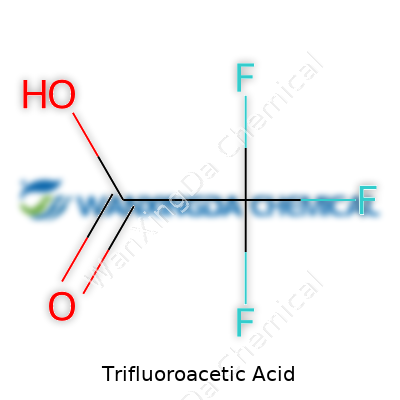
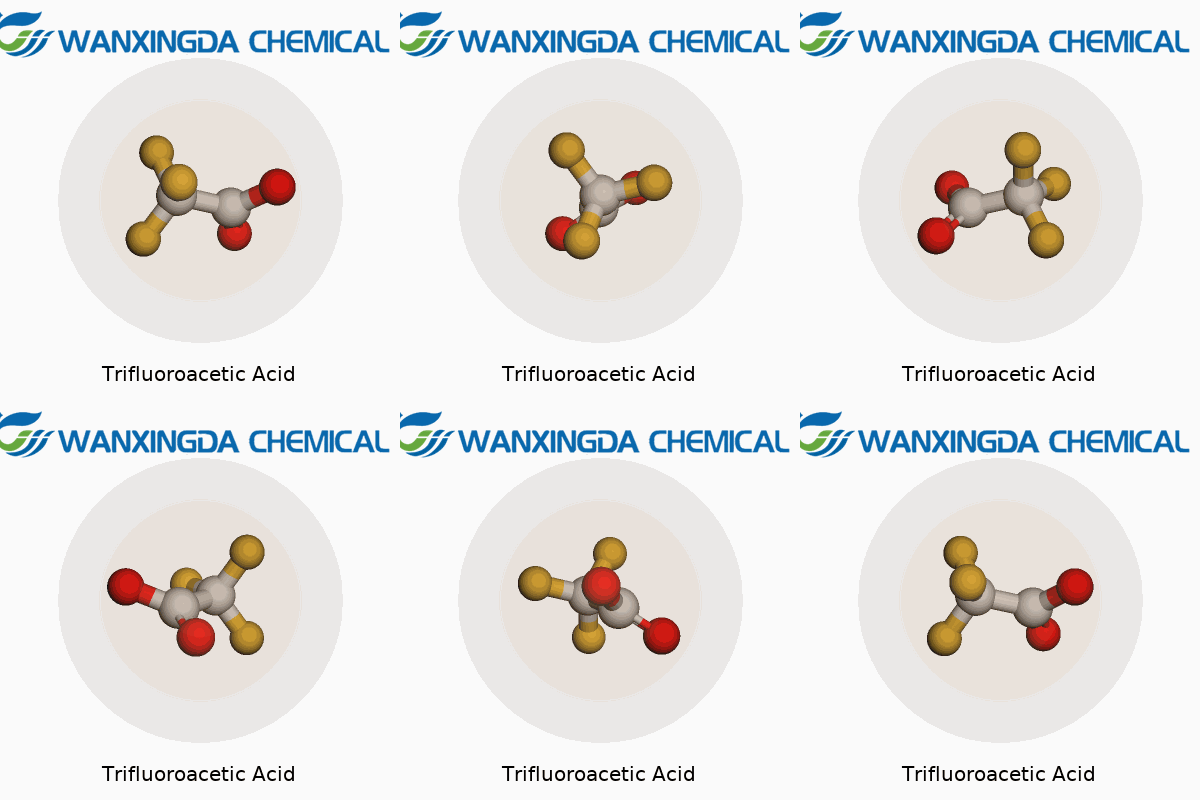
Trifluoroacetic Acid: Chemistry, History, and Tomorrow’s Questions
Historical Development
Trifluoroacetic acid, often shortened to TFA, owes much of its trajectory to the growth of organic chemistry in the twentieth century. Chemists searching for powerful reagents stumbled on the value of adding fluorine atoms to classical acetic acid. This wasn’t just a tweak; it turned a fairly ordinary compound into a tool that could unlock reactions once seen as too challenging or time-consuming. Fluorine’s electron-withdrawing nature boosted the acid’s strength by orders of magnitude. By the 1960s, researchers in both academics and industry had started leaning heavily on TFA for peptide synthesis—back then, the hope was to speed up what had been a painfully slow set of reactions. As pharmaceutical science and polymer research grew, so did the reputation and demand for TFA. From humble lab beginnings, it found a quiet home on the bench of most chemistry departments.
Product Overview
Looking at a clear, colorless liquid in a glass bottle rarely hints at the reach of TFA. You’d find it in bottles with tight seals, as the vapors climb quickly and cause irritation. But where synthetic organic chemistry needs a punchy acid with non-nucleophilic properties, TFA slots in. Its presence changed how scientists could deprotect amino acids, play with sensitive reagents, and push through dress-rehearsals for drugs without pulling in water or introducing chaos with side reactions. TFA became a staple for making peptides, the building blocks used in countless therapies and biological investigations. Its role covers lab benches, scale-up reactors, and advanced research into greener synthesis methods.
Physical & Chemical Properties
You can’t ignore TFA’s sharp odor—it’s a warning that the fumes shouldn’t linger too long around your face. The molecular formula, CF3COOH, tells you three fluorine atoms amplify acidity, giving a pKa of about 0.23. Water and most organic solvents dissolve TFA easily, and its boiling point lands around 72 degrees Celsius, which is modest compared to many strong acids. The low viscosity and high volatility mean TFA always feels restless in open air, transferring to your gloves, bench, or the extractor hood with ease. It behaves as one of the stronger carboxylic acids, punishing glassware or careless handling.
Technical Specifications & Labeling
Industry players pay close attention to trace water and halogen content in TFA. Too much water dilutes its acidity, changing reactions. Purity levels higher than 99 percent are common for synthetic chemists. Labels flag corrosivity, the risk of inhalation injury, and environmental threats if spilled or drained away. Anyone handing out TFA on a commercial scale must use UN-approved bottles and maintain paperwork for shipment, given its place among hazardous chemicals.
Preparation Method
Electrochemical fluorination sits at the core of most industrial TFA production. Starting with acetic acid or acetyl chloride, large companies pass electricity through mixtures of hydrofluoric acid, swapping hydrogen atoms for fluorine. This route bears its own dangers, as hydrogen fluoride itself needs careful handling. Once formed, TFA undergoes distillation and drying, ensuring minimal contamination. This workhorse chemistry supports its global supply chain, pumping thousands of tons annually for everything from research to industrial purification.
Chemical Reactions & Modifications
Chemists use TFA’s strong acidity and resistance to nucleophilic attack to protect fragile molecules during synthesis. TFA cleaves protecting groups, especially the tert-butyloxycarbonyl (Boc) group in peptide chemistry. With three fluorines tightly bonded, TFA shrugs off most attempts at nucleophilic substitution, which sets it apart from other acids. Combining TFA with other reagents sometimes produces trifluoroacetate esters, which themselves hold use as intermediates in complex organic synthesis. Unlike many acids, TFA oxidizes poorly and rarely forms polymers, but it can react with alcohols and amines to make derivatives handy for labeling or purification.
Synonyms & Product Names
Chemists learn early on that TFA passes under several banners. Beyond trifluoroacetic acid, it shows up as 2,2,2-trifluoroethanoic acid or even perfluoroacetic acid. Synonyms don’t change its attitude in the lab; the acid remains brutal on contaminants and responsive in certain analytical methods. Companies market TFA under various grade descriptors—electronics, synthesis, chromatography—each flagged for slightly different impurity profiles, but the basic rules never shift.
Safety & Operational Standards
Wearing face protection, rubber gloves, and working in a chemical hood all come into play when tackling TFA. If spilled, its high vapor pressure brings fumes fast, which catch the eyes and lungs. Direct skin contact feels much like a scald—painful, destructive, and urgent. Long exposure increases the odds of chronic irritation and nasal injury. Guidelines by global chemical safety bodies, such as OSHA and the European Chemicals Agency, describe limits on permitted workplace air concentrations, strict disposal routes, and antidote methods for accidental spills. Younger researchers often underestimate the risk of inhaling even small amounts; personnel training and proper fume hoods prove essential.
Application Area
Few acids gained such quick adoption in the world of protein chemistry as TFA. Its knack for removing boc protecting groups without causing a fight with side chains reshaped how researchers build peptide drugs. TFA’s value extends to HPLC analysis, where adding small amounts to aqueous phases improves separation and suppresses tailing in reverse-phase chromatography. In environmental science, TFA shows up during the breakdown of certain refrigerants and fluorinated pesticides, complicating water monitoring tasks. Beyond these, TFA supports the manufacture of specialty polymers and fine chemicals, especially where other acids would either introduce water or trigger unwanted rearrangements.
Research & Development
Chemists challenge TFA’s status as a waste product by finding ‘greener’ synthesis paths. Current investigations look at electrochemical methods that minimize hazardous fluoride waste. Enzyme-catalyzed modifications remain out of reach, partly because TFA’s acidity degrades biological catalysts. In the analytical lab, the drive to develop TFA alternatives for chromatography stems from its persistence in water and limited biodegradability. Biotech firms went looking for milder acids that do the same job in peptide synthesis, but no perfect match has surfaced. That leaves TFA as a mainstay, even as questions linger over supplier carbon footprints, supply chain transparency, and handling practices across different countries.
Toxicity Research
Multiple animal studies confirm what lab workers sense: TFA, even in low concentrations, irritates tissue and disrupts metabolism. Inhalation leaves lungs inflamed and sometimes impairs breathing. Chronic exposure drew links to liver and kidney stress. The environmental footprint earns equal scrutiny. Once TFA seeps into waterways, it holds its form—resistant to sunlight, heat, or most common bacteria. Long-term residue sits in drinking water and the soil. Research teams are monitoring the impact on aquatic life and looking for secondary effects on food chains. Direct ingestion proves hazardous for mammals and birds, leading to more calls for controlled disposal at every step of the supply chain.
Future Prospects
Rethinking TFA’s role in chemistry seems certain as regulatory bodies focus more closely on persistent environmental chemicals. The pressure to swap out TFA for less harmful agents keeps growing, but so far, those replacements lack its unique balance of strength, volatility, and low nucleophilicity. Recycling systems that recover and purify waste TFA could take off, aided by advances in membrane separation and selective distillation. In pharmaceuticals, rapid drug discovery cycles favor reagents that perform reliably at scale, and TFA still fits that bill. Persistent research into analogs and better waste-minimization strategies looks set to chart TFA’s next chapters. The tension between utility and risk—familiar to anyone who’s ever tried to balance lab speed and safety—frames the dilemma facing not just chemists, but the regulators, water authorities, and communities downstream from today’s labs.
Behind the Lab Doors
Stepping into any well-used chemistry lab, you’ll spot shelves lined with containers labeled with intimidating names. Trifluoroacetic acid, usually known as TFA, often claims a spot in the lineup. For many scientists, TFA stands out as both a workhorse and something to treat with respect. I remember the sharp, biting smell—chemical burns into memory—and the care every lab member uses around it. That caution exists for a reason. TFA brings serious reactivity to the table, and more than a few essential roles across different fields.
Protein Chemistry’s Friend and Foe
Ask a biochemist about preparing peptides, and TFA comes up almost immediately. In peptide synthesis, it strips away protecting groups. These chemical barriers let researchers build complex molecules one piece at a time, but the process grinds to a halt unless someone can remove them at the right moment. TFA does this in a quick, almost merciless fashion. Anyone who has worked through the slow, careful assembly of a peptide chain knows the relief in seeing TFA dismantle those groups efficiently.
Without TFA, much of the rapid progress in peptide therapeutics and protein engineering would crawl at a much slower pace. Many of the cutting-edge drugs for cancer or immune diseases trace part of their origins back to this acidic liquid. The risks are real—the fumes demand a fume hood, the liquid etches glass if you let it linger—but so are the rewards.
Chemical Synthesis and Industry Use
Beyond biology, TFA serves a long list of uses in synthesis labs. Separating compounds, cleaning reaction mixtures, or making things as routine as pharmaceuticals all count on its predictability and strength. TFA’s strong acidity rivals sulfuric acid but comes in a smaller, more wieldy package. Its volatility lets it evaporate cleanly after use, leaving the desired reaction product uncontaminated.
Pharmaceutical companies lean hard on TFA to shape molecules with the right features. The purity it delivers helps guarantee a safe and effective final product. Chemical researchers have published thousands of papers over the past decades showing what’s possible because TFA reacts vigorously but predictably in so many settings.
Trouble in the Waste
Now, there’s a darker side to all of this. TFA persists stubbornly in the environment. It resists breaking down, and over time, low but measurable levels accumulate in water and soil. I remember reading research about TFA in rainwater, tracing its path back to industrial emissions and even refrigerant breakdown products. Fields that depend on precise reactions now face tough questions about how to minimize their TFA footprint.
Some labs now emphasize greener alternatives or recovery systems to snag TFA before it enters waste streams. Technologies for reclaiming and recycling TFA can lessen long-term harm, but adoption takes time and investment. Education makes a difference here, too. New chemists need to learn both the science and the environmental cost, pushing for changes from within.
Looking Ahead with Open Eyes
TFA isn’t going anywhere soon. Its place in both research and industry appears locked in, for now. Still, the conversation must shift towards balance. Progress in medicine and chemistry saves and improves lives, but environmental responsibility deserves just as much focus. When I work with TFA, I see both the promise of discovery and the privilege—and burden—of stewardship. That mix of awe and caution is something every chemist learns in time.
Everyday Risks in the Research Lab
Walking into a chemistry lab, sharp smells and the sting in your nose become familiar companions. Trifluoroacetic acid—or TFA for short—carries its own sharp reminder: powerful, persistent, and not to be underestimated. This chemical isn’t just any acid. Its small, clear appearance masks some big dangers, and it sticks out in my memory as one of the few that makes trained chemists stand a little straighter when handling it.
The Sour Truth about TFA
TFA eats through gloves, vaporizes at room temperature, and chews through metal if left unchecked. Its main use turns up all over organic chemistry—peptide synthesis, cleaning up reaction products, making pharmaceuticals. Many experts, including those who set safety rules worldwide, rank TFA pretty high on the hazard scale. It’s corrosive enough to cause instant burns if splashed on skin. Fumes can scorch your lungs with just a short exposure, sometimes leaving scars that last for years. Eyes aren't spared either; even a trace amount spells trouble. A single fume whiff brings a burning tickle deep in your chest, and I still carry a memory of one minor mishap that ended with me under the emergency eyewash—hoping for the best, cursing myself for rushing.
Why the Hype? Facts on Safety and Health
The Material Safety Data Sheet tells the story bluntly. TFA burns just like concentrated sulfuric acid, but with volatile fumes that sneak up faster. Animal studies show it can damage lungs and harm liver and kidneys over time. The acid doesn’t just sting; it sets off a chain reaction—especially for folks with allergies or asthma. Compared to other acids, the fluorine atoms packed inside boost reactivity and persistence, even after diluted in water. It doesn’t fade away quickly in the environment either, so a spill means real trouble for wildlife and water sources nearby.
No Shortcut to Safe Handling
TFA’s dangers never felt abstract to me. Lab accidents have a way of stripping away all those confident “I’m careful, it won’t happen to me” thoughts. Wearing the right gloves (nitrile, not latex), double-checking the fume hood, and watching out for even tiny bottle cracks—these steps protect real lives. I’ve seen folks brush off a near miss and return to old habits—until the next accident nudges everyone back to vigilance.
Building Safe Habits: What Works
All the training in the world means nothing if we get comfortable and cut corners. Sharing stories of close calls keeps everyone on their toes. Swapping latex for nitrile gloves, setting up spill kits within reach, and making goggles non-negotiable has nudged my team away from luck and toward real safety culture. Proper disposal and spill response plans sound boring, but a single careless rinse down the drain pushes toxic residues out into the world. Group reminders, a “buddy check” on gear before pouring, and honest talks about mistakes saved us from bigger problems more than once.
The Future of Chemistry Needs Smarter Choices
TFA is simply one of many chemicals where risk and reward walk side by side. New substitutes pop up now and then, but the classic case remains: for every powerful tool in the lab, the most important safeguard looks back at me in the mirror. Small habits shape safety far more than the latest warning sign, and open talk about risk keeps hands steady—no shortcuts, just respect for what’s on the bench.
Understanding the Real Hazards
Anyone who has worked in a chemistry lab has probably caught that stinging whiff of Trifluoroacetic Acid (TFA) at least once. Its sharp, almost medicinal smell lingers, and it isn’t just unpleasant—it’s a red flag. TFA ranks high on the danger scale because of its volatility and strength. Missteps around strong acids can trigger chemical burns or lung irritation. I’ve seen glassware pitted and gloves eaten through when TFA spills. That kind of risk makes safe storage essential, not just for compliance, but for keeping people healthy in the lab.
What Safe Storage Actually Looks Like
There’s a lot of talk about safety in labs, but action separates a safe workspace from an accident waiting to happen. TFA should go straight into a chemical storage cabinet built for corrosive acids. Keep it away from metal shelves—TFA can corrode metal and create a serious mess. Cabinets made of polyethylene or similar acid-resistant materials hold up far better in my experience.
Lab shelves sometimes get overcrowded. Bottles get bumped, and something as unforgiving as TFA needs a stable spot at eye level or below, never up high where an accidental drop could turn into an emergency. Ventilated cabinets can help keep fumes from building up, which matters more than a label might suggest—those fumes are no joke.
Why the Right Containers Make a Difference
Original containers play a big role. Manufacturers ship TFA in thick, tightly sealed bottles for a reason. If you ever have to transfer it, use high-quality bottles designed for strong acids. Glass seems like a classic choice, but I’ve seen TFA slowly eat through the wrong kind over time. Polyethylene or Teflon containers usually hold up best. Screw tops must seal tightly to stop vapors from escaping and to keep moisture from creeping in.
Spotting the Hidden Threats
It’s not just about what you put next to TFA, but also what you keep far away. Bases and oxidizers don’t mix with strong acids—store those in separate cabinets entirely. Water itself poses a hazard; TFA fumes grab moisture from the air, making handling without gloves and goggles a shortcut to disaster. Every person who works near it should know that even quick exposure can be dangerous.
Learning from Experience
Over the years, I’ve watched colleagues get comfortable around chemicals and cut corners. It starts small—leaving a bottle out on the bench, skipping a check of the cap. Once TFA started leaking slowly, the cabinet floor became sticky, and it took hours to scrub the vapor residue off. Building good habits and routine checks into daily lab work keeps that kind of headache from cropping up. Spills get wiped up immediately with proper neutralizers, not water, and lids go back on bottles right away.
Bright Spots: Practical Solutions
Ventilated storage cabinets, acid-resistant mats, and clear signage go a long way. Training isn’t a one-and-done box to check—it needs regular updates and practice drills, especially for new staff. If budgets allow, automated fume sensors add another layer of safety by spotting vapors before noses do. Every lab should make sure any storage policy goes beyond rulebooks and actually fits real-world work—because keeping everyone safe matters more than checking a compliance box.
Digging Into Trifluoroacetic Acid’s Formula and Weight
Trifluoroacetic acid isn’t just a mouthful to say—it pops up over and over whenever scientists and chemists go looking for a hard-working acid that can get things done where standard acids fall short. This stuff goes by the chemical formula C2HF3O2, packing two carbon atoms, a single hydrogen atom, three fluorines, and two oxygens into one small but formidable molecule. That mix gives it a molecular weight of 114.02 grams per mole.
What Sets Trifluoroacetic Acid Apart?
Ask anyone who’s spent time in a laboratory, and you’ll get stories—some good, some less so—about using trifluoroacetic acid, often called TFA. TFA’s claim to fame sits with its strength. It’s a “super acid” compared to the more relaxed acids folks remember from high school classes. TFA stands out because fluorine doesn’t play around: this halogen ramps up the molecule’s acidity way past acetic acid, its more laid-back cousin from vinegar bottles and pickle jars.
People might think this is chemistry jargon, but the knock-on effect shows up all over organic chemistry labs. Need to remove a stubborn protecting group from a molecule? TFA often becomes the tool of choice. It slices off specific chemical fragments cleanly, like a sharp knife through ripe fruit, letting researchers move forward with new recipes and experiments without messing up other parts of the molecule. This isn’t just lab trivia—it’s the difference between grinding for weeks and making real progress in days.
Why Chemical Details Really Matter
It seems easy to dismiss the formula and molecular weight as technical filler, but these details have real consequences for accuracy and safety. Lab work depends on precision. The wrong amount—just a few decimal points out—can ruin data, waste time, or worse, put people at risk if hazardous fumes get loose. Knowing trifluoroacetic acid’s exact formula means researchers can calculate how much to use, predict how it’ll react with other chemicals, and stay ahead of dangerous surprises.
On the educational side, young chemists need repeated practice working with numbers and formulas like C2HF3O2. This sort of repetition cements the foundation for safe habits and sound procedures. Overlooking the basics just piles up risk. In my own time training new lab staff, I saw how careful handling of these acids—double-checking molecular weight every time—cut down on mistakes and made the work go smoother.
A Closer Look at Responsibility and Safety
TFA’s popularity brings its own set of worries. With strength comes the demand for respect. Even experienced researchers forget how easily TFA fumes can sting the nose and eyes or corrode simple materials. Consistent attention to safety makes a difference: fume hoods, gloves, and airtight storage turn into non-negotiables, not afterthoughts. In research centers, sharing this sort of practical advice—alongside all the number crunching—has become as important as memorizing the details from the textbook. Every safety review or pre-work briefing benefits from explicitly pointing out trifluoroacetic acid’s formula and weight, making those numbers matter not just to the science but to the people doing it.
Looking for Good Solutions, Every Day
Making sure everyone has quick access to up-to-date data on chemicals like TFA could start with better training and clearer digital tools right in the lab. Experienced staff can mentor new learners, highlighting the link between the formula—C2HF3O2—the molecular weight, and all the real-world steps for safe handling. Chemistry doesn’t reward shortcuts; it rewards the folks who pay attention. For trifluoroacetic acid, knowing those core details keeps research flowing and people safe, one careful calculation at a time.
Real Dangers Behind Common Laboratory Chemicals
Trifluoroacetic acid—often called TFA—shows up a lot in labs, trusted for its strength and versatility. But once it’s done its job, getting rid of it isn’t as simple as pouring it down the drain. In my years handling chemicals, I’ve learned that rushing through disposal or treating it as just “another acid” invites trouble for everyone. TFA sticks out because of its volatility, toxicity, and stubborn environmental persistence. It affects not just the person holding the pipette but also the ground, water, and air we all share.
Understanding the Risks
The first time TFA splashed near my gloves, I felt my heart rate spike. It’s not only caustic to the skin; its fumes alone can irritate airways. That’s where respect for the acid kicks in. Improper disposal isn’t just a regulatory problem. TFA breaks down slowly in nature, leading to bioaccumulation. Research out of Europe has tracked increased levels in groundwater and rivers, raising alarm bells among scientists. If it moves beyond the lab, it lingers in our ecosystem for years. Fish, insects, plants—all start to show stress. Getting these facts straight makes it clear that cutting corners really does cause harm beyond the lab bench.
The Steps That Protect Us All
Good lab habits protect more than your own hands. Labs that set up proper neutralization and collection don’t just avoid fines—they help keep local water sources clean. Straight neutralization with a base sounds like a quick fix, but TFA’s strength means it reacts violently if dumped all at once into a container of sodium bicarbonate. I’ve seen containers foam and boil over, risking splashes. Adding acid to base slowly, with stirring, stops most of those surprises.
After neutralizing, the resulting waste doesn’t belong in the sewer. TFA salts still carry risks. The best practice always comes back to setting up a labeled, closed container—one that won’t corrode or leak. Colleagues of mine miss this step and spend extra days cleaning up accidents. Waste management companies then haul these containers away for incineration at licensed facilities. Burning at high temperature breaks down the tough molecules, stopping them from building up in the environment.
Training Makes a Difference
I meet plenty of new graduates who are surprised by the paperwork and protocols tied to acid disposal. They sometimes see it as a chore rather than a safety step. But looking at case studies or visiting a water treatment plant changes minds quickly. Local regulations differ, but the general principles hold: know your material, respect the risks, keep things contained, and send waste only to people equipped for safe destruction. Your local environmental health and safety office should always get a call if questions pop up. I’ve seen more issues caused by silent confusion than by asking “too many” questions.
A Culture Shift, Not a One-Off Task
It’s easy to see disposal as the end of the process, but TFA’s resilience demands ongoing attention. Supervisors who talk openly about risks and encourage careful work help set a higher standard. If enough of us drill down on these habits, sooner or later it adds up to cleaner labs, safer colleagues, and fewer headlines about chemicals in the wrong place. Handling acids with care—especially ones as persistent as TFA—protects so much more than a single project. It safeguards the web of life stretching out well beyond lab walls.